Woman Scan
Gynecological Protection and Hormonal Balance Package
The female body possesses a magnificent biological system with different needs at every stage of life. Our gynecological screening package analyzes every detail, from your reproductive health to bone quality and from hormonal balance to cellular health, through an expert perspective.
1. Contrast-Enhanced Pelvic MRI
The pelvic region (lower abdomen) houses vital organs such as the uterus (womb), ovaries, fallopian tubes, and bladder.
The specialized contrast agent administered to the patient allows us to see the blood circulation patterns and tissue structure of the organs with crystal clarity.
It helps us create the most accurate treatment map by identifying the anatomical boundaries of myomas (fibroids), cysts, endometriosis (chocolate cysts), or suspicious masses.
2. DEXA (Bone Densitometry)
DEXA, a measurement of bone density, is used to detect the weakening of bone structure (osteoporosis or bone loss) that can occur especially in women along with hormonal changes.
We measure bone mineral density in critical areas such as the hip (femur) and the lower spine (vertebra). By detecting silent bone loss early, we enable you to take precautions to prevent potential fractures.
3. Cancer Screening Tests (Tumor Markers)
These tests decipher the body's biochemical language, allowing us to catch clues at the cellular level before structural changes even occur:
CA 125: The most critical indicator in gynecological oncology, especially for monitoring ovarian tissue.
CEA: A comprehensive examination providing information about the digestive system and overall cellular health.
CA 19-9: Monitors the health of the pancreas and biliary tract.
CA 15-3: A sensitive tracker for monitoring changes in breast tissue.
4. Hormone Screening Panel
Hormones regulate everything from your energy levels and menstrual cycle to your fertility and mood.
AMH (Anti-Müllerian Hormone): The most reliable test showing your ovarian reserve, essentially your "biological clock."
FSH & LH: These regulate the communication between the pituitary gland in the brain and the ovaries, overseeing the ovulation process.
Estradiol (E2): The most active form of estrogen, the primary female hormone; it is critical for reproductive health and bone protection.
Prolaktin: Known as the milk hormone, its imbalance can directly affect the menstrual cycle and fertility.
5. Complete Urinalysis (TIT)
This checks the body's overall metabolic state and kidney health. It provides quick and clear information about silent urinary tract infections or kidney filtration capacity.
Additional Option via Physician Interpretation HSG (Hysterosalpingography)
Based on your examination and test results, HSG (Uterine Film) can be added to our package if deemed necessary by your doctor.
This film, taken with a specialized fluid injected into the uterus, checks the internal structure of the uterus and whether the fallopian tubes are open. It is the most reliable diagnostic method for detecting potential blockages in the tubes or intra-uterine adhesions, especially for women planning a pregnancy.
Family Physician Consultation and Proper Guidance
We do not leave you in a state of uncertainty once all these advanced tests are completed:
All your results are reviewed as a whole by our expert Family Physician.
Our physician meets with you one-on-one to explain your results and interpret the general trajectory of your health.
If a specific finding is detected in your tests, our physician will direct you to the relevant specialist (Cardiologist, Oncologist, etc.), ensuring you receive the most accurate treatment without delay.
Biopsy and Pathology
If our doctor identifies a suspicious cluster of cells in the screening results, they may request a biopsy and pathology to obtain the "identity card" of those cells.
While imaging tells us "there is something there," a biopsy tells us "what that something is." This is the gold standard for determining whether suspicious cells are benign or malignant. An accurate diagnosis is the only way to establish the most effective treatment plan.
Breast Health Protection Package Protect Your Future with the Power of Early Diagnosis
In breast health, which is one of the most critical aspects of women's health, "being aware" saves lives. This package, prepared with the most advanced technological devices and detailed laboratory analyses, examines your breast tissue both structurally and biologically.
1. Digital Mammography (Bilateral)
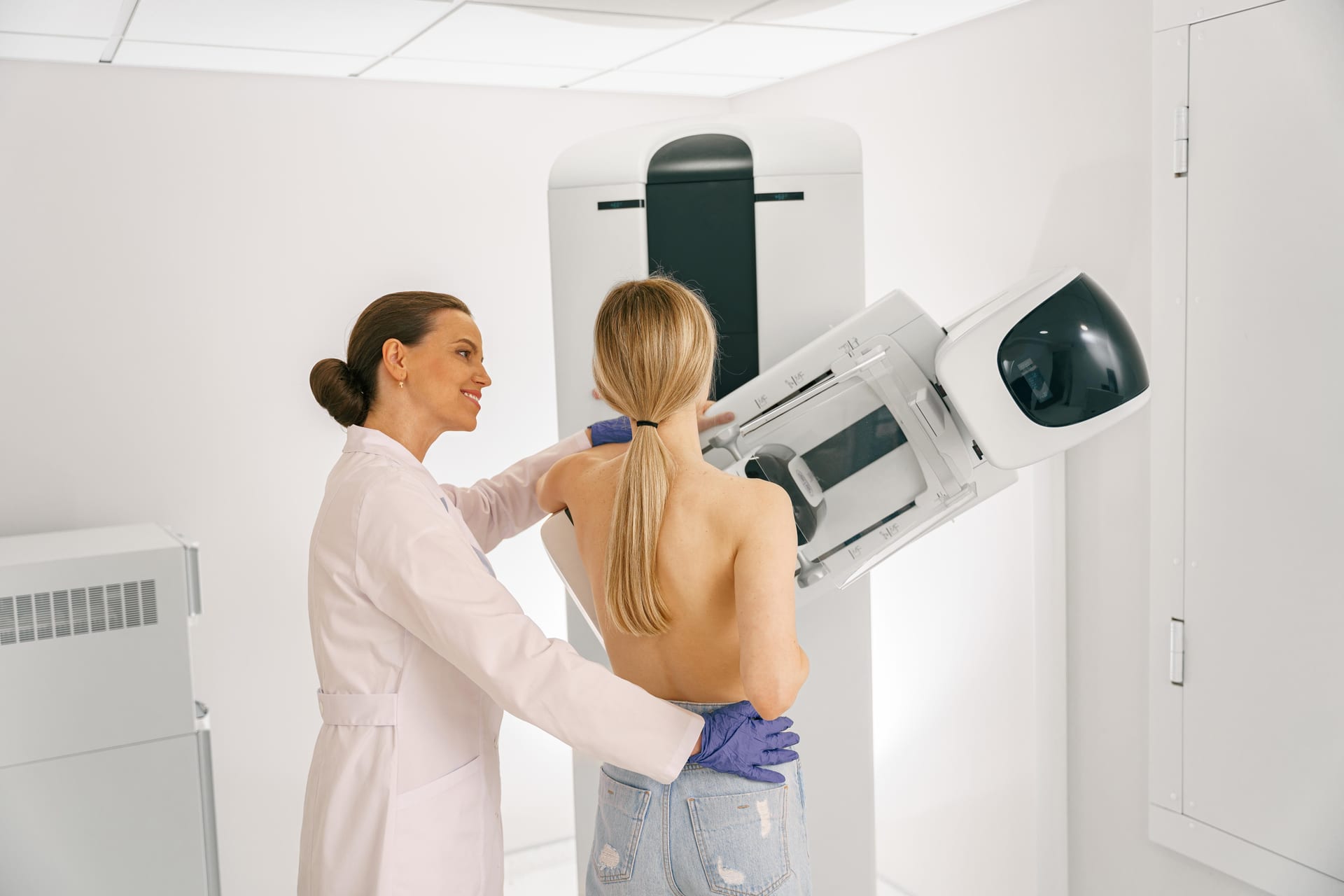
The gold standard in the fight against breast cancer, Digital Mammography is a high-resolution digital image of the breast tissue.
It detects minute (millimetric) changes and calcifications (microcalcifications) that cannot yet be noticed through manual examination at an early stage.
It emits much less radiation compared to traditional methods, and since contrast settings of the images can be adjusted in a digital environment, it provides our physicians the opportunity to examine even the finest details. Scanning both breasts maximizes diagnostic accuracy by allowing for symmetry control.
2. Breast Ultrasound (Bilateral)
The most powerful complement to mammography, Breast Ultrasound images breast tissue in a radiation-free manner using high-frequency sound waves.
It illuminates "blind spots" that mammography might not "see," especially in young women or individuals with dense breast tissue. It allows us to understand not just that a mass is present, but whether it is fluid-filled (cyst) or a solid tissue (solid mass). Since it involves no radiation, it is an extremely safe and comfortable examination method.
3. Advanced Cancer Screening Tests (Tumor Markers)
While providing "structural" control through imaging methods, we create a "biological" map of your body through blood tests. These tests are sensitive messengers that track changes in your cells:
CA 15-3 (Breast Specific): The most important biomarker used to monitor cellular changes in breast tissue. It is of primary importance, especially for the monitoring of breast health.
CA 125 (Gynecological Follow-up): Although it generally monitors ovarian tissue, it plays a critical role in understanding the overall oncological balance and intra-abdominal health of the female body.
CEA (Carcinoembryonic Antigen): A general tumor marker; it allows us to track potential risks, particularly in the gastrointestinal (digestive) system and other organs.
CA 19-9: Monitors your pancreas and hepatobiliary (bile duct) system health. It is included to detect any deviation in the body's internal balance.
Family Physician Consultation and Proper Guidance
We do not leave you in a state of uncertainty once all these advanced tests are completed:
All your results are comprehensively reviewed as a whole by our specialist Family Physician.
Our physician meets with you one-on-one to explain your results and interpret the general trajectory of your health.
If a specific finding is detected in your tests, our physician will direct you to the relevant specialist (Cardiologist, Oncologist, etc.), ensuring you receive the most accurate treatment without delay.
Biopsy and Pathology
If our doctor identifies a suspicious cluster of cells in the screening results, they may request a biopsy and pathology to obtain the "identity card" of those cells.
Imaging tells us "there is something there," while biopsy tells us "what that something is." This is the gold standard for determining whether suspicious cells are benign or malignant. An accurate diagnosis is the only way to establish the most effective treatment plan.
Exclusively for Expectant Mothers Advanced HSG (Hysterosalpingogram) Package
Starting the pregnancy journey with confidence begins with checking the path.
For women dreaming of motherhood, one of the most important steps is ensuring that the "path" where this miraculous journey takes place is open and healthy. Our Advanced HSG package is specially designed for women who plan to conceive but have not achieved results for a while, or those who want to start the process from the most accurate point.
Next Generation HSG (Hysterosalpingogram)
Unlike traditional methods, the Advanced HSG technique we apply at our center is performed with modern technologies that maintain patient comfort at the highest level.
For pregnancy to occur, the fallopian tubes must be open and the uterus must be structured to accept the baby. HSG is the only and most reliable method to check the "passageway" of this system.
Thanks to the use of new-generation, thin, and soft catheters and specialized contrast media, the procedure turns into a much more comfortable and short-term experience for our patients.
With the latest digital X-ray technology, intra-uterine adhesions, polyps, or millimetric blockages in the tubes are detected in their clearest form.
It clarifies whether the tubes, through which the egg reaches the uterus, are open. Sometimes, the procedure itself can naturally increase the chance of pregnancy by opening minor blockages in the tubes.
The structure of the uterine lining where the baby will settle, congenital deformities, or subsequently formed obstacles (myoma, polyp) are examined in detail.
Your results and digital images are prepared within 1 hour after the procedure.
Specialist Family Physician Consultation and Guidance
We do not just send you away with a report after the HSG scan
The captured film is examined in detail by our specialist physicians.
If a blockage in the tubes or a condition preventing pregnancy in the uterus is detected, your doctor will plan the most appropriate treatment method (such as laparoscopy, IUI/insemination, or IVF) without losing time.
Our goal is not just to diagnose, but to eliminate biological obstacles in the journey of becoming a mother with scientific data.
Post Menopausal Bone Health Protection Package: Strong Bones, A Secure Future
Menopause, a natural and mature stage of a woman's life, brings along certain biological changes. Our skeletal system is at the forefront of the systems most affected by these changes. We are here for you with the most advanced DEXA technology to protect your bones and step into the future with confidence during the post-menopausal period.
What is DEXA (Bone Densitometry)
DEXA is a screening method considered the gold standard for measuring the density of calcium and other minerals that provide bone hardness and durability. Using a very low dose of X-rays, it reports the strength of your bone structure with millimetric precision.
Why is it Vital During Menopause
The most important shield protecting bones against degradation in the female body is the hormone estrogen. With menopause, the decrease in estrogen levels causes bones to lose minerals and their internal structure to weaken, becoming "porous."
Osteoporosis Risk: Osteoporosis, commonly known as bone loss, can progress without any symptoms. DEXA is the only method that catches this process while it is still in its early stages (osteopenia).
Expert Opinion and Guidance
After your DEXA results are out, our specialist Family Physician analyzes the data in detail. They inform you about the status of your bone health (Normal, Osteopenia, or Osteoporosis) and, if necessary, direct you to a Physical Therapy or Endocrinology specialist to ensure your treatment begins in the most accurate way.